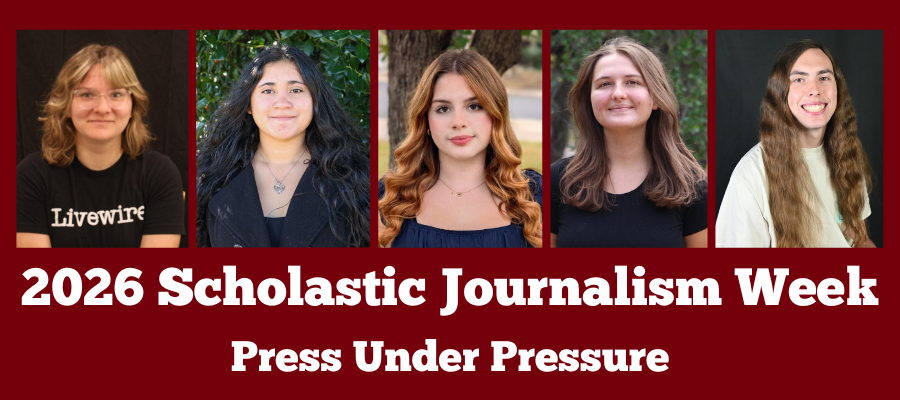
The Journalism Education Association celebrates Scholastic Journalism Week each year with a different theme centered on student media and the challenges faced by young journalists. This year’s theme is “Press Under Pressure,” to emphasize the importance of scholastic journalism and balancing ethical reporting with pressure filled situations. Five students discussed their roles as journalists and reflected on each day of Scholastic Journalism Week.
Day 1: Don’t Fold Under Fake
Day 1 addresses the struggle of creating an accurate angle in media without accentuating details for “clicks.” Alexa Vititoe, website editor for Livewire at Bullitt East High School (KY), encourages her staff to use multiple perspectives to develop a well-rounded story. Her approach to authenticity in an article is researching the topic with trusted news sources and constructing an individual idea of what the story should be about.
“Hard facts are very necessary when it comes to reporting news,” Vititoe said. “I don’t believe that reporting news should be a bias… the hard facts are very important in keeping the population updated with the truth.”
Day 2: Reporting in the Fire
Day 2 centers on the high-stress environment journalists can be flung into at a moment’s notice. Kenia Gonzalez-Chavez, news editor for Blueprints at Cedar Shoals High School (GA), felt pressure when writing an in-depth story regarding safety precautions at her high school.
“You don’t want to write something that could cause harm to the community,” Gonzalez-Chavez said.
After a discussion with her editors and adviser, she decided to take on the project and prioritized keeping her sources safe while educating the community.
“I would for sure encourage every student journalist to tackle stories that may look kind of scary,” Gonzalez-Chavez said. “If you actually want to do it and want to make an impact in your community, do it.”
Day 3: Pressure Makes Professionals
Day 3 brings the hard truth that working hard through intense circumstances is what makes the best journalists. Elizabeth Yowell, print editor-in-chief of the Dispatch at James Bowie High School (TX), felt a lot of pressure when writing about modern masculinity standards. She observed students at her school, let the research guide her angle, and brought the facts to every aspect of the work.
“If I don’t have the facts then there’s no foundation for my story,” Yowell said.
Yowell feels a lot of pressure when addressing controversial topics, but she used her knowledge and accumulated facts to build good conversations with her sources. She remembers the value of press freedom when deciding to tackle an important issue in her writing.
“Press freedom is so important so that we can cover these things and educate our peers and try to make the world a better place in any way that we can,” Yowell said.
Day 4: Student Press Freedom Day
Student Press Freedom Day is a reminder to student journalists that they deserve the same rights and protections as professionals. Liberty Pittman, media editor-in-chief of the Dispatch at James Bowie High School (TX), leaves the brainstorming up to her staff so they can cover what they feel is most important.
“We want everybody to have the option to choose which story feels the most interesting to them in order to have the most interesting stories,” Pittman said.
Her staff also takes initiative by asking members of the student body what they wish to read about. Pittman makes brainstorming a community aspect so the students are satisfied with their work as well.
“We know what our student body thinks is an issue, who they think should be covered, what they think should be covered” Pittman said.
Pittman is grateful that her school’s leadership does not attempt to put restraint on their work as student journalists and promotes free speech on campus.
Day 5: Truth Against the Clock
Every journalist feels the strain of a looming deadline, but creating a good piece trumps the timing for Noah Iverson, co-editor-in-chief of Tribal Tribune at Wando High School (SC).
“When it comes to accuracy, it doesn’t matter if you miss the deadline,” Iverson said. “If the story doesn’t tell the audience an accurate telling of what’s going on with facts and quotes, it’s a failed story.”
Iverson feels it is his responsibility as a leader to communicate the importance of building a story correctly, regardless of the publication date.
“The most important part is accuracy, no matter how long you need to postpone that story to make sure it’s the right story for the reader,” Iverson said.
Thank you to every student journalist who makes their voice heard, and happy Scholastic Journalism Week!